超级战舰
Exclusive: ‘Like ripples on the sea’: Chinese astronomer tells Global Times how the Milky Way got its newly discovered ‘wrinkles’_我的网站

一 |
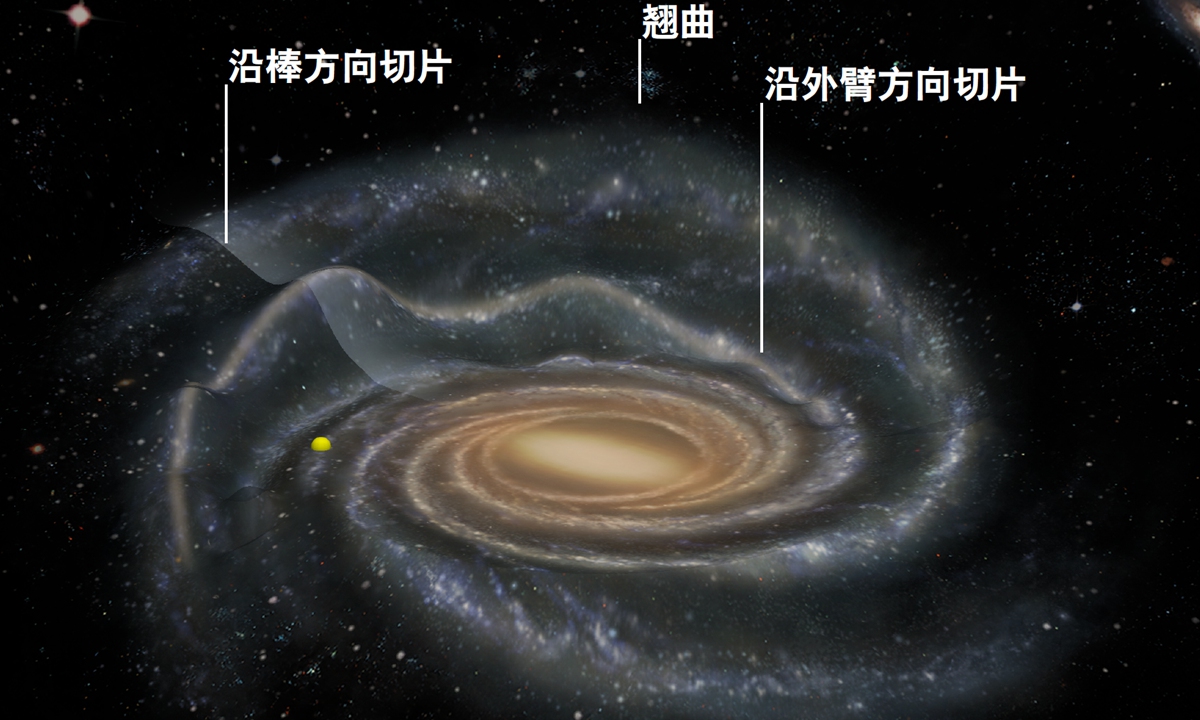
Schematic diagram of Milky Way Photo: Courtesy of Purple Mountain Observatory (PMO)
Chinese astronomers have discovered that the Milky Way is not a simple, smoothly warped disk, but contains widespread "wrinkle-like" structures resembling ripples on a water surface, providing new clues to understanding the galaxy's 3D structure and evolutionary history.
The discovery was made by a research team from the Purple Mountain Observatory (PMO) under the Chinese Academy of Sciences, using data from the "Milky Way Imaging Scroll Painting" (MWISP) survey. The findings were published online titled "Widespread corrugations superimposed on the Galactic warp in the outer CO disk" in the journal
Nature Astronomy on August 7.
For decades, astronomers have known that the Milky Way's disk is not perfectly flat. Instead, its outer regions are slightly bent upward on one side and downward on the other - a structure known as a galactic warp.
However, the latest study shows that this large-scale bending is not the whole story. Smaller-scale vertical fluctuations are also embedded within the warped disk, creating a more complicated 3D structure.
"In many illustrations and in the public imagination, the Milky Way looks like a flat vinyl record," Sun Yan, associate researcher at PMO and the first author of the paper, told the Global Times on Tuesday. "In reality, the outer part of the Milky Way is more like a record that has been heated and deformed, with one side lifted and the other side lowered. That is the warp. On top of this large-scale deformation, there are additional smaller waves, which we call corrugations," Sun explained.
Using a more everyday analogy, Sun compared the Milky Way's structure to a sea surface. The warp is like a large swell that changes the overall height of the ocean, while corrugations are smaller waves superimposed on that swell.
"The two structures exist together. In our data analysis, we first removed the large-scale warp model, which allowed us to reveal the smaller wave-like patterns hidden underneath," Sun said.
The research focused on the Milky Way's outer gas disk rather than the more familiar stellar disk. According to Sun, cold molecular gas and stars provide two complementary ways to study the galaxy.
"Molecular gas is a sensitive probe for studying the vertical structure and dynamics of the galactic disk because it is concentrated near the disk plane and responds strongly to disturbances," she said.
Molecular gas is also the raw material for star formation, meaning its distribution is closely connected with the formation of young stars. The researchers traced this gas through carbon monoxide (CO) emission, which can penetrate regions obscured by interstellar dust and provide a different perspective from optical observations of stars.
The breakthrough was made possible by the MWISP survey, conducted using China's 13.7-meter millimeter-wave telescope.
"MWISP can be understood as giving the Milky Way a large-scale medical examination using millimeter-wave observations," Sun said.
Previous CO surveys were limited in sensitivity and coverage, making it difficult to accurately study the distant outer regions of the galaxy. In contrast, the latest study identified more than 30,000 molecular cloud samples, covering about half of the Milky Way's outer disk and extending to a distance of about 26 kiloparsecs from the Galactic center.
With such a large dataset, researchers were able to first establish a model of the overall warp and then separate subtle structures from the background. The newly identified corrugations have radial wavelengths of about 3.9-7.9 kiloparsecs and vertical amplitudes of about 100-200 parsecs.
The study also identified a corrugation structure extending about 40 kiloparsecs in azimuth at a distance of around 12.7 kiloparsecs from the Galactic center. In some spiral arm regions, vertical displacements can reach approximately 200 parsecs.
The researchers believe these large-scale vertical fluctuations are likely related to "bending waves" triggered by external gravitational disturbances, suggesting that the Milky Way might have experienced more complex interactions during its evolutionary history.
Although the newly discovered structures sound dramatic, they do not have any direct impact on Earth or the solar system. "Humans cannot directly sense these corrugations," Sun said. "Their scales reach thousands or even tens of thousands of light-years, and even if these structures are evolving, such changes would not be directly perceptible on human timescales."
The study focuses on the outer disk of the Milky Way and does not include the region around the solar system. "There is currently no evidence that these structures have any observable influence on Earth's environment," Sun said.
Instead, their significance lies in what they reveal about the past. Like geological layers recording Earth's history, these galactic structures preserve traces of the Milky Way's evolutionary journey, the researchers explained.
Researchers said future studies combining more precise motion measurements and numerical simulations could further reveal the origins of these structures and their role in the long-term evolution of the Milky Way.
。

二 | 水是构成人体成分的重要物质并发挥着重要的生理作用,足量饮水是保障身体健康的基础,也能帮我们维持正常的身体活动和认知能力。近期,《美国国家科学院院刊》发布了一项惊人研究,揭示每升瓶装水中平均含有约24万个可检出的塑料微粒,并且,瓶装水在我们反复开关以及高温暴晒的条件下会使水中含有更多的微塑料。这些纳米级的塑料颗粒能够进入我们的肠道或肺部细胞,进而穿越血液,抵达心脏和大脑,甚至对孕妇而言,它们能穿越胎盘,进入胎儿体内。 那么,面对这样的污染,我们如何保障自己的饮水安全呢?把水烧开能否有效降低微塑料的含量呢? 1.微塑料对人体有什么危害? 微塑料是指直径小于5毫米的塑料颗粒,更小尺寸的还有微米、纳米级的微塑料,因此它也被统称为微纳塑料(MNPs)。微塑料来源于生产和生活,如汽车轮胎与路面摩擦、化妆品成分、洗衣废水以及塑料垃圾在陆地和海洋漂流中碰撞、分解等,都会产生大量微塑料。 随着研究的深入,目前微塑料的概念已经扩大到从纳米到毫米的范畴(1毫米等于1000微米;1微米等于1000纳米),而且是形状多样的非均匀塑料颗粒混合体,肉眼难以分辨。微塑料对人体健康的潜在影响:包括可能诱发氧化应激、促进炎症、内分泌紊乱和代谢紊乱等,从而增加多种疾病发生风险。 2.把水烧开是一种简单有效降低微塑料含量的方法 近期关于瓶装水中微塑料的研究结果令人震惊,这让我们不得不重新审视我们的饮水习惯。对于大多数家庭来说,把水烧开是一种简单且有效的杀菌方法。

三 | 关于微塑料,烧开水确实能在一定程度上降低其含量。当水被烧开时,微塑料颗粒会与水中的碳酸钙结合,形成沉淀物。

四 | 通过简单的过滤,我们可以去除高达84%的微塑料。因此,把水烧开再喝,确实是一个降低微塑料摄入的有效方法。

五 | 当水被加热至沸腾时,微塑料颗粒由于密度和大小的差异,会与水中的其他物质发生分离,一部分会沉淀到水底。因此,在烧开水之后,如果条件允许,我们可以使用过滤器或纱布进行简单的过滤,进一步减少水中的微塑料颗粒。 3.如何保证饮水安全? (1)选择质量好的瓶装水:购买瓶装水时,注意查看产品标签和认证信息,选择有质量保证的品牌。

六 | 避免购买来源不明或价格过于低廉的瓶装水。 (2)定期更换水壶和水杯:即使是高质量的水壶和水杯,长期使用也可能磨损,导致微塑料产生。建议定期更换,保持清洁。 (3)安装家用净水器:安装家用净水器可以有效去除水中的杂质和微塑料颗粒,提供更安全的饮用水。

七 | (4)使用不锈钢或玻璃材质水壶:烧水更安全,因为这些材质不易释放微塑料颗粒。 所以,我们要尽量避免使用塑料水壶,尤其是在高温下,塑料中的化学物质可能会加速分解,增加微塑料的风险。减塑降碳。图源:卡乐图片(摄影/宁颖) 4.减少微塑料摄入的生活小妙招 科学家建议,由于微塑料主要通过饮食和器具进入人体,一些生活方式也有助于减少微塑料的摄入。 (1)尽量减少选用预包装食品,特别是加工程度非常高的食品。每一个加工过程都可能会增加食品当中微塑料的含量,尽可能吃一些原型的食物,同时减少塑料容器包装的食品摄入。 (2)平时不食用动物、鱼类的内脏。海洋本身就存在着微塑料的污染,鱼类以及海产品长期生活在这个环境中,所含的微塑料就会更高,经常食用海鲜或者深海鱼,摄入微塑料的含量也会增多。 (3)减少外卖和快餐的摄入。外卖和快餐包装中常含有大量塑料,不仅可能产生微塑料,还可能含有其他有害物质。尽量自己做饭,既健康又环保。 (4)不粘锅出现划痕后尽量不要再用。大多数不粘锅的不粘涂层通常是聚四氟乙烯,也就是特氟龙,属于一种合成塑料。

八 | 当炊具表面和硬物之间有强烈磨损时,可能会形成微小的聚四氟乙烯颗粒,然后污染食物被人类摄食。别用不粘锅烹调质地坚硬的食物,比如排骨,不使用尖锐的铲子,并定期更换新锅。 (透视社综合中国青年报、北京日报、封面新闻、“科普中国”微信公众号报道) 编辑:李煦、廖明娟(实习) 校对:李旭颖 审核:龚紫陌。
Current article:http://gyb.tibiantasangnenti.buzz/th3/dm6eve7.html
Published on:12:31:16


